India’s Nuclear Milestone: Kalpakkam Fast Breeder Reactor Achieves Criticality | Khabar For You
- Khabar Editor
- 09 Apr, 2026
- 47

Email:-infokhabarforyou@gmail.com
Instagram:-@khabar_for_you


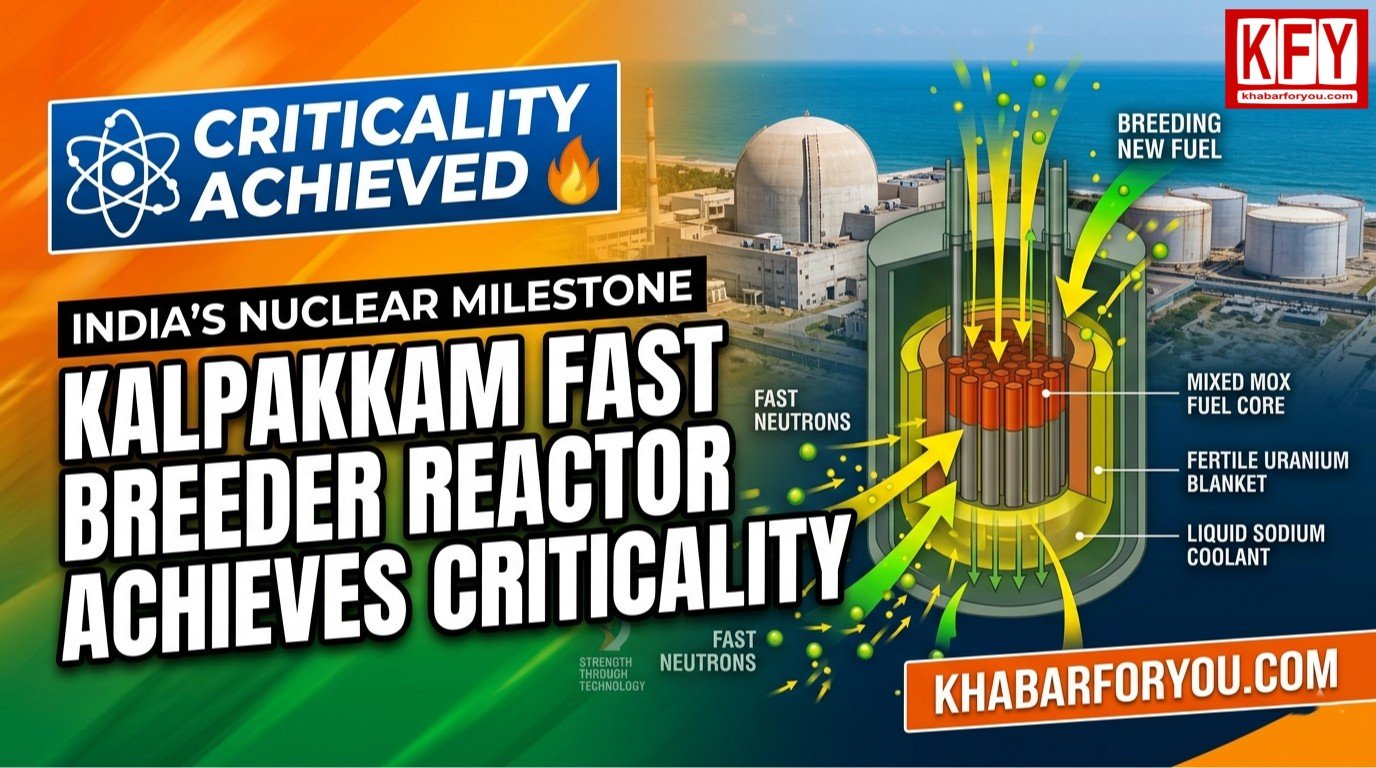
On the evening of April 6, 2026, at precisely 8:25 PM, a hushed silence fell over the Control Room of the Prototype Fast Breeder Reactor (PFBR) in Kalpakkam. After twenty years of delays, cost overruns, and international skepticism, the "First Criticality" was achieved. For the uninitiated, "criticality" sounds ominous; for the scientists at BHAVINI and IGCAR, it is the holy grail - the moment a nuclear heart begins to beat on its own.
India has now become only the second country in the world, after Russia, to operate a commercial-scale Fast Breeder Reactor. But behind the celebratory tweets and the Prime Minister’s "Defining Step" declaration lies a story of staggering engineering complexity and a high-stakes gamble on a technology most of the world abandoned decades ago.
Read More - Modi’s 6 Guarantees for Bengal 2026: Investigative Report on BJP’s Vision for Nabanna | KhabarForYou
The ‘Breeder’ Alchemy: Making More Than You Burn
To understand why Kalpakkam is the crown jewel of India’s Department of Atomic Energy (DAE), one must understand the "Breeder" concept. Conventional reactors (like the ones at Tarapur or Kudankulam) are like wood stoves: you put in uranium, it burns, and you are left with ash.
The PFBR is different. It is designed to be a "perpetual" energy machine. It uses a core of Mixed Oxide (MOX) fuel - a potent cocktail of Plutonium and Uranium. Surrounding this core is a "blanket" of Uranium-238. As the reactor runs, the fast-moving neutrons don't just generate heat; they strike the blanket and transmute the "fertile" Uranium-238 into "fissile" Plutonium-239.
Essentially, for every 100 atoms of fuel the reactor consumes, it creates nearly 110 to 120 atoms of new fuel.
"We are moving from a regime of scarcity to a regime of abundance," a senior scientist at the Indira Gandhi Centre for Atomic Research (IGCAR) told *Khabar For You* on the condition of anonymity. "This reactor is the bridge to our Stage-3 goal: using our massive thorium reserves. Without the PFBR, thorium is just sand. With it, thorium is the future of Indian energy."
The Three-Stage Dream: Bhabha’s Legacy
The PFBR is the linchpin of the "Three-Stage Nuclear Programme" envisioned by Dr. Homi J. Bhabha in the 1950s.
1. Stage 1: Natural Uranium reactors (PHWRs) generate power and produce Plutonium as a byproduct.
2. Stage 2: Fast Breeder Reactors (like Kalpakkam) use that Plutonium to "breed" more fuel and eventually convert Thorium into Uranium-233.
3. Stage 3: Large-scale Thorium-based reactors provide centuries of clean energy.
India holds 25% of the world’s thorium but very little uranium. By achieving criticality at Kalpakkam, India has officially unlocked the door to Stage 2, breaking the "uranium shackles" that have long made the country dependent on imports from Kazakhstan and Canada.
The Sodium Challenge: A Dangerous Coolant?
The road to April 6 was paved with technical nightmares. Unlike conventional reactors that use water as a coolant, the PFBR uses **Liquid Sodium**.
Sodium is an engineer's dream and a safety officer's nightmare. It is an excellent heat conductor, but it is "pyrophoric"—it catches fire instantly if it touches air and explodes if it touches water. Handling 1,750 tonnes of molten sodium circulating at temperatures upwards of 500°C required the development of specialized pumps and double-walled heat exchangers that had never been built in India before.
"The world watched us fail for years," says a former director of BHAVINI. "In the 1970s and 80s, France, the US, and Germany tried breeders and gave up because sodium leaks were too frequent and repairs too costly. We persisted because we had no choice. For India, it was energy independence or bust."
The Investigative Lens: Cost of a Dream
While the achievement is historic, it comes at a steep price. Originally sanctioned in 2003 with a budget of ₹3,492 crore and a completion date of 2010, the project has seen its timeline double and its costs balloon to over ₹9,000 crore.
A recent 2026 Parliamentary Standing Committee report highlighted "systemic over-estimation" and "significant anomalies" in the DAE’s head-wise expenditure. Critics argue that the two-decade delay has allowed renewable energy - solar and wind - to become significantly cheaper than nuclear power.
However, the DAE counters that renewables cannot provide "baseload" power. When the sun sets and the wind stops, a 500 MWe reactor like the PFBR provides a steady, carbon-free flow of electricity that can power millions of homes 24/7.
Safety and the Road Ahead
The Atomic Energy Regulatory Board (AERB) granted the "First Approach to Criticality" only after a multi-tier safety review. Unlike the Fukushima-style reactors, the PFBR is designed with "passive safety" features. If power fails, the physics of the reactor core is designed to naturally shut down the chain reaction without human intervention.
What’s next?
Criticality is only the beginning. Over the next few months, the reactor's power levels will be raised in increments—5%, 10%, 25%—as engineers test every valve and sensor. If all goes according to plan, the Kalpakkam PFBR will be synchronized with the national grid by December 2026, marking the first time a "breeder" electron lights up an Indian home.
The Global Perspective: An Atomic Outlier
In an era where many Western nations are decommissioning nuclear plants, India is doubling down. With the "Viksit Bharat 2047" vision targeting 100 GW of nuclear power, the success at Kalpakkam is more than just a scientific milestone; it is a statement of geopolitical intent.
As the world looks on, the shores of the Bay of Bengal are now home to a machine that promises to solve India's energy hunger once and for all. The "Atomic Ashwatthama" - the reactor that never dies - has finally woken up.
Business, Sports, Lifestyle ,Politics ,Entertainment ,Technology ,National ,World ,Travel ,Editorial and Article में सबसे बड़ी समाचार कहानियों के शीर्ष पर बने रहने के लिए, हमारे subscriber-to-our-newsletter khabarforyou.com पर बॉटम लाइन पर साइन अप करें। |
| यदि आपके या आपके किसी जानने वाले के पास प्रकाशित करने के लिए कोई समाचार है, तो इस हेल्पलाइन पर कॉल करें या व्हाट्सअप करें: 8502024040 |
#KFY #KFYNEWS #KHABARFORYOU #WORLDNEWS
नवीनतम PODCAST सुनें, केवल The FM Yours पर
Click for more trending Khabar
Leave a Reply
Your email address will not be published. Required fields are marked *
Search
Category